
On a piece of jewelry, the marks tell you everything — who made it, where, and when.
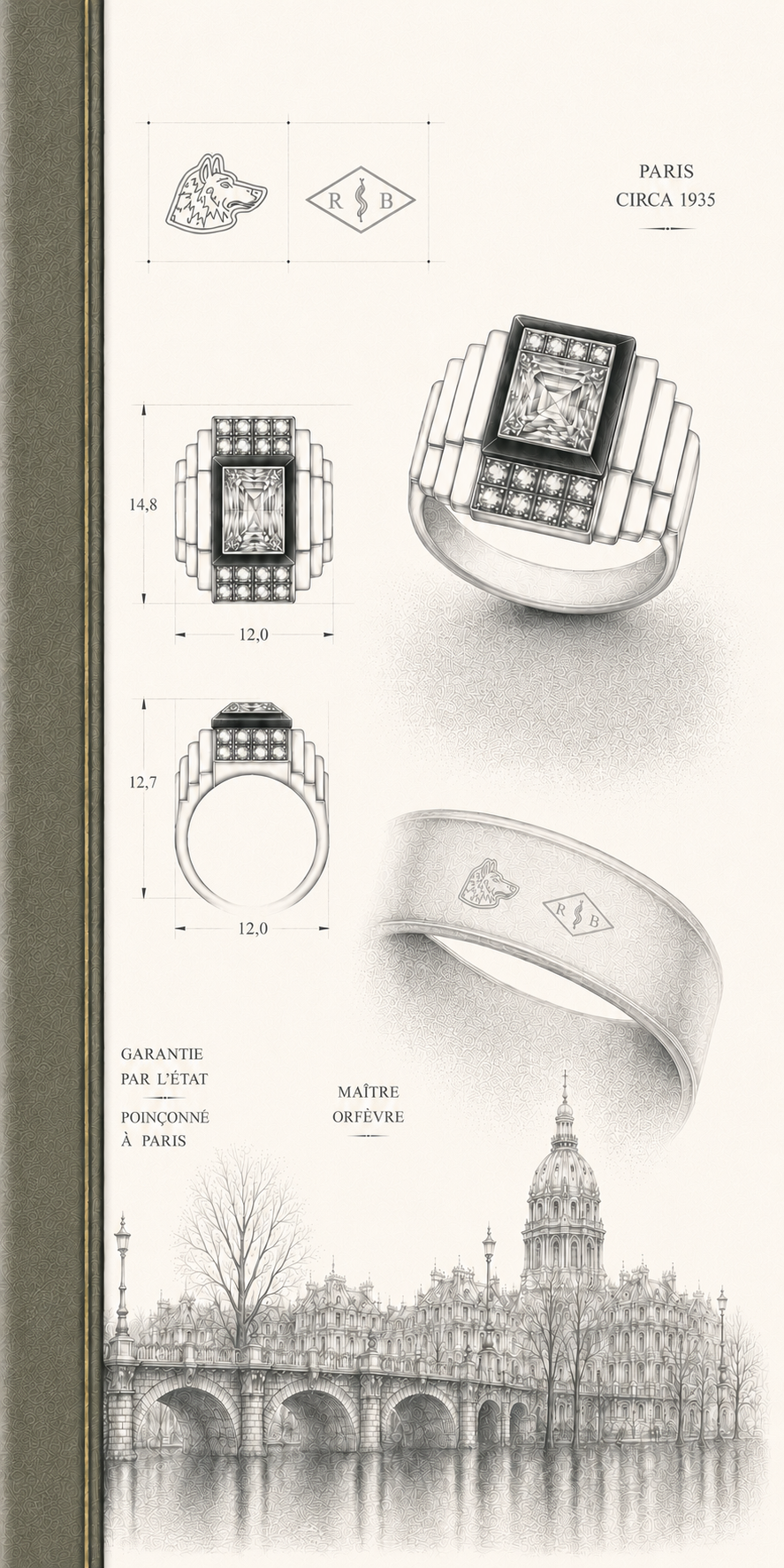
The Marks
What makes a piece identifiable is often not immediately visible. A tiny signature, the way a clasp is constructed, the proportions of a setting, the placement of an engraving — details that situate an object within a place, a period, and a tradition. Often, the decisive clue is no larger than a few millimeters.
France developed one of the most rigorous systems of hallmarking and traceability in the jewelry world. Workshop signatures, state hallmarks, and assay punches were established not as decorative details, but as instruments of identification and authentication. Together, they link a jewel to a maker, a city, and a moment in time. Over the years, they also became an essential historical language for collectors, dealers, and specialists.
The French poinçon de maître — traditionally struck within a lozenge-shaped cartouche containing initials and a distinguishing symbol — remains one of the most recognizable features of the French system. Applied alongside official state hallmarks, it created a dual form of authentication: one from the workshop, the other from the assay office.
Interpreting these details is a discipline. They are small, often worn, sometimes partially erased by time, polishing, resizing, or repair. A single punch may confirm an attribution, reveal a later alteration, or entirely change the understanding of a piece. Yet such indications are rarely definitive on their own. They must remain coherent with the construction, materials, workmanship, and visual language of the object itself.
Recognizing these consistencies — or inconsistencies — requires years spent handling jewelry, studying historical references, and developing the visual memory that comes with time. Construction, proportions, wear patterns, engraving style, and mounting techniques all contribute to the reading of an object. Hallmarks are only one element within a larger vocabulary.
David Chassard developed a specialization in French signed jewelry and historical hallmarks, with particular attention to twentieth-century French makers and workshops. His expertise was formed through years spent handling objects, comparing details, researching attributions, and working closely with dealers and specialists within the trade. Collectors and professionals consult him when a jewel requires closer examination — to identify a maker, confirm a period, refine an attribution, or better understand a detail that might otherwise pass unnoticed.
Like many specialized traditions, this knowledge evolves through observation, experience, and exchange — carried forward across generations within the trade.
Working with David
Many conversations begin with a piece that raises questions.
A mark that cannot be placed immediately.
An uncertain attribution.
A detail that deserves a closer reading.
Understanding a piece more clearly is often the beginning of a larger opportunity — acquisition, partnership, or sale.
TRADE INQUIRIES ONLY